The Atlantic Companion · Wild Atlantic Way · Clare

Welcome to The Burren.
We're glad you're here.

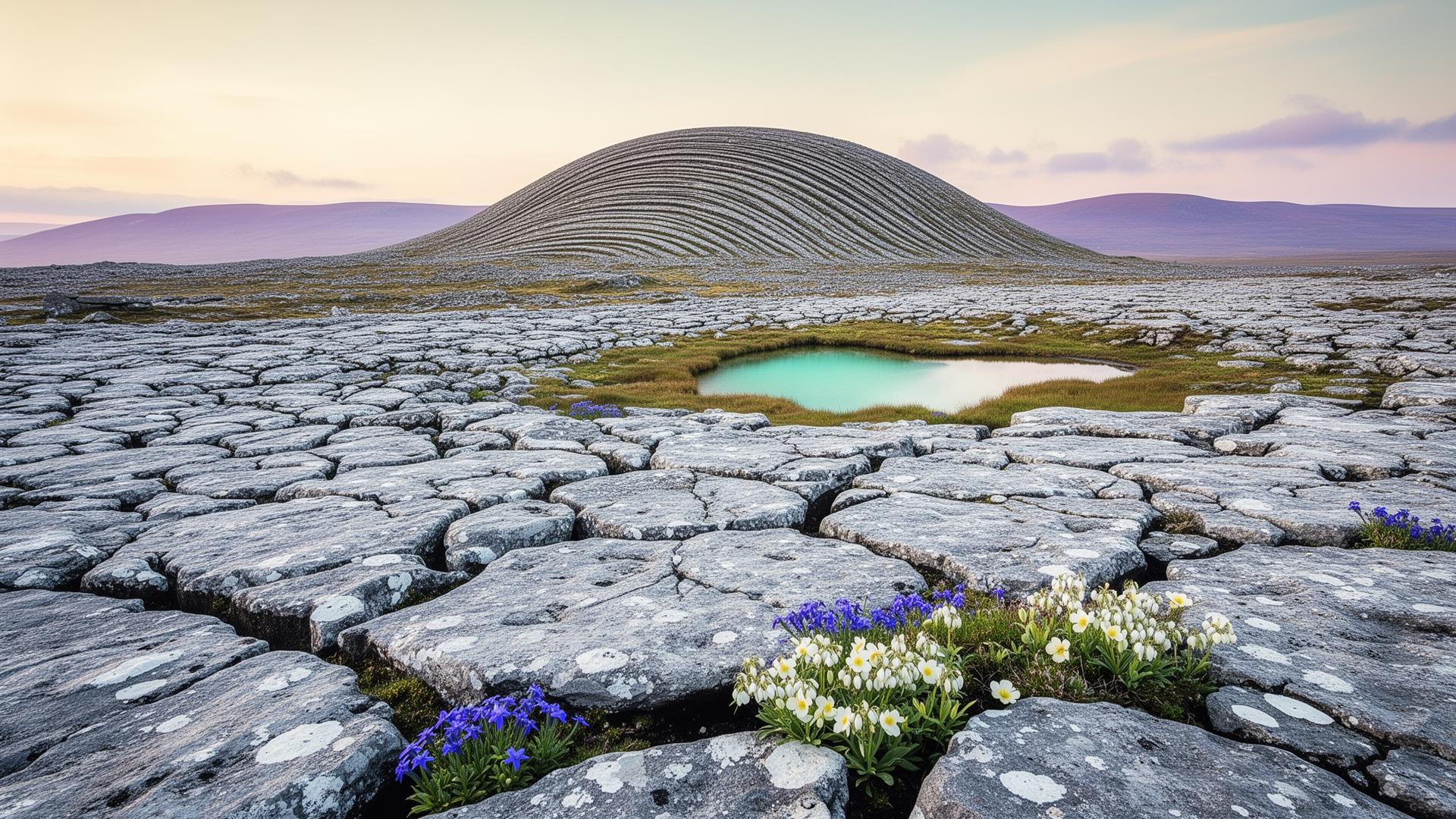
The Burren — Boirinn, 'a stony place' — is a 530km² karst plateau in north Clare and south Galway, where limestone laid down on a tropical sea bed 350 million years ago has been scoured by glaciers into terraces, pavements and underground rivers. Mediterranean, Arctic and alpine plants grow side by side here in conditions that exist nowhere else. Six thousand years of farmers, monks, and tomb-builders have left dolmens, ringforts and monasteries across the stone. Lisdoonvarna and Ballyvaughan are the two villages that anchor it.

Limestone pavement, rare orchids, and 6,000 years of human marks.

Sharing from the Wild Atlantic Way

You're in The Burren. Send it to someone who'd love it.

First things first

Where are you headed next?

Tell us once and we'll shape the rest of the page around it.

The essentials

What you shouldn't miss.

Locally chosen, not algorithmic. In rough order of "if you only do one thing".

History

Poulnabrone Dolmen

A 5,800-year-old portal tomb — older than the Pyramids — sitting on a slab of limestone pavement off the R480. The remains of at least 33 people have been found here. The dolmen's silhouette against the Burren sky is one of the most photographed images in Ireland.

Good to know · Free, always open. Small car park signposted off the R480. Stay on the path — the surrounding pavement is fragile.

Nature

Burren National Park

1,500 hectares of karst, hazel scrub and turlough (vanishing lake) at Mullaghmore mountain — the eastern Burren. Several waymarked walking routes from a free car park. The Mullaghmore loop walk is the headline — a circuit of the eerily layered limestone hill.

Good to know · Free park, free car park near Corofin. Information point in Corofin village. Best in spring for the orchids and gentians.

Nature

Aillwee Cave

A horizontal cave system opened by farmer Jacko McGann in 1944 when he chased a dog into a hole. Stalactites, an underground waterfall, the bones of brown bears that hibernated here 10,000 years ago. The Birds of Prey Centre alongside flies eagles and owls daily in season.

Good to know · Off the R480 near Ballyvaughan. Open daily. Combined cave + birds ticket. Allow 2 hours.

Town

Ballyvaughan

A small fishing village on Galway Bay at the northern edge of the Burren. The 19th-century pier, Monks pub on the harbour, and An Fear Gorta tea-room (in a 19th-century cottage) are the destinations. The Burren Smokehouse in Lisdoonvarna and Burren Free Range pork have made the area a serious slow-food region.

Good to know · Free parking on the pier. Most facilities concentrated on the central junction.

Town

Lisdoonvarna

The country's last working spa town — sulphur and iron springs at the Spa Wells beside the river. Famous for the Matchmaking Festival every September, founded in the 1800s as a post-harvest meeting for farmers and now one of Europe's biggest singles events. Willie Daly — fifth-generation matchmaker — holds court at The Matchmaker Bar with his leather-bound book of lonely hearts; touch it with both hands and you're meant to be married within six months. The Burren Smokehouse and the Roadside Tavern (with the in-house Burren Brewery) are the year-round draws.

Good to know · Pay-and-display on Main Square. Spa Wells partly seasonal — check current opening hours before visiting.

Nature

The spring gentian — the flower that brought a king

Gentiana verna — a tiny, electric-blue alpine flower that grows wild on the Burren limestone and almost nowhere else in Ireland or Britain. It's the flower that drew Charles here as Prince of Wales in May 2002, and again as King in 2024 — he's a long-standing patron of the Burrenbeo Trust. Most visitors walk straight past it; once you've seen the colour, you don't again. Look low, in the cracks of the pavement.

Good to know · Bloom window is roughly mid-April to early June, peak in May. Best seen in Burren National Park (Mullaghmore loop) and around Mullach Mór. Don't pick — it's protected.

History

Corcomroe Abbey

A roofless 13th-century Cistercian abbey set in a karst valley below Abbey Hill. The carved tomb of King Conor O'Brien (died 1267) is inside. WB Yeats set his play 'The Dreaming of the Bones' here. Often empty, always atmospheric.

Good to know · Signposted off the N67 north of Bell Harbour. Free, always open. No facilities.
Local businesses

Places we'd point a friend to.

Hand-picked, not paid for. The ferries, the beds, the pubs and the bike hire that make a visit work.

Before you go. These listings are compiled from public sources and aren't yet verified by the businesses themselves. Hours, menus and prices change with the seasons — always check directly with the venue before travelling, and book ahead in July and August. Owners can get in touch to update their listing.

Eat

Drink

Drink

The Matchmaker Bar

Willie Daly's pub on Main Street in Lisdoonvarna — Ireland's last full-time traditional matchmaker, fifth generation, with a battered leather book of names that's the bar's most famous object. Heart of the Matchmaking Festival every September; sessions and singles year-round. Touch the book.

Where
Main Street, Lisdoonvarna, Co. Clare

Stay

Shop

Do

Run a place in The Burren?

Our directory is curated, not pay-to-play. If we'd recommend you, you can be on here.

See how to get listed

Got a window or a counter?

Download a free A5 QR card for The Burren — print it, stick it up, and visitors land straight on the The Burren guide.

Ask a local

The bits that aren't on Google.

Off the spine

Worth leaving the route for.

Not on the Wild Atlantic Way — but a short drive inland (or further along the coast) and locals would always send you here.

Common questions

What people ask about The Burren.

What is the Burren?

The Burren (Boireann, 'great rock') is a 250 km² limestone karst plateau in north County Clare, characterised by bare grey pavements of cracked rock, rare wildflowers (Arctic, alpine and Mediterranean species growing side by side), prehistoric tombs and ring forts, and an extraordinary concentration of medieval and earlier monuments per square kilometre.

What is there to see in the Burren?

Headline stops are Poulnabrone Dolmen (a 5,800-year-old portal tomb), the Caherconnell ring fort, the Burren National Park visitor centre at Corofin, Aillwee Cave and Birds of Prey Centre, Mullaghmore Mountain, and the long limestone foreshore at Black Head. The Cliffs of Moher sit on the south-western edge of the Burren.

Where should I stay to explore the Burren?

Doolin is the best base if you want to combine the Burren with the Cliffs of Moher and Aran Islands ferries. Ballyvaughan, on the north Burren coast, is closer to Poulnabrone and the limestone pavements. Lisdoonvarna sits in the middle and has the largest range of accommodation.

Is Poulnabrone Dolmen worth visiting?

Yes — Poulnabrone is one of the most iconic prehistoric monuments in Ireland, a portal tomb built around 3,800 BC and excavated to reveal the remains of more than 30 people. It's free, signposted off the R480, and a 5-minute walk from the small car park. Allow 30 minutes including time on the surrounding limestone pavement.

Practical

The things you'll wish you'd known.

Fuel
Lisdoonvarna and Ballyvaughan. Ennistymon and Kilfenora as backup.
Cash
Lisdoonvarna and Ballyvaughan. Bring some — pavement-side honesty boxes still operate at smaller sites.
Pharmacy
Lisdoonvarna. Ennis or Galway for anything urgent.
Parking
Free at Poulnabrone, Burren National Park, Corcomroe. Pay-and-display in Lisdoonvarna.
Phone signal
Patchy across the karst. Download maps before you head off the main roads.
When to come
May–early June for the wildflower bloom — the Burren's best month, and not crowded.

Designed & developed by ideapath.app